Boilers and thermoblocks describe heating hardware. PID describes a method of controlling that heating. An espresso machine can combine a boiler with PID control, or use PID with a flow-through heating system. Understanding both parts helps explain how a machine prepares brewing water, produces steam and responds to a changing workload.
This guide explains the principles behind the terminology, with practical questions for a home coffee bar or café. The labels describe parts of a system; the complete design determines how that system behaves.
At a glance: three separate questions
Where and how does water receive heat?
A boiler heats a contained volume of water. A thermoblock transfers heat to water travelling through an internal water path.
How is the heating output regulated?
A PID controller uses a target and temperature feedback to calculate the heating response. It can work with different heater arrangements.
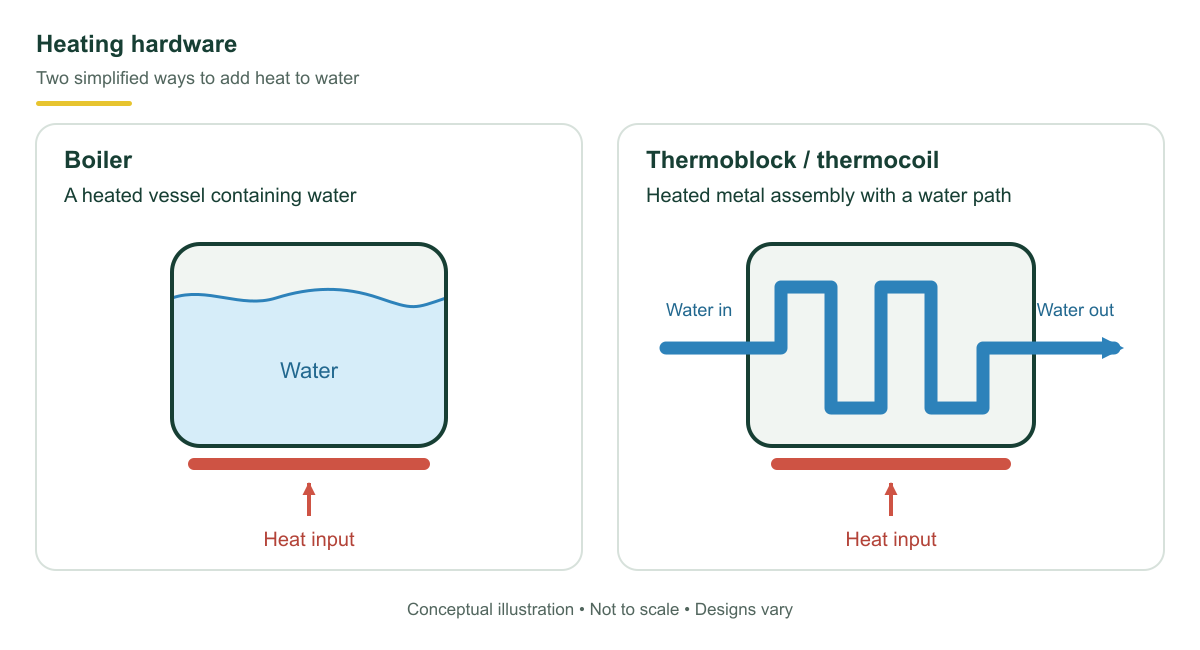
A boiler uses a heating element to heat water in a vessel. The water's intended job matters: brewing and steam production require different operating conditions. Common espresso-machine arrangements handle those jobs in different ways.
The water and vessel store thermal energy. When cooler water enters, more heat must be transferred to bring it to the intended temperature. The stored heat, heater response and water path all contribute to how the system responds during use.
| Arrangement | How the heating duties are organised | What to check in use |
|---|---|---|
| Single-boiler dual-use (SBDU) | One boiler switches between a brewing temperature state and a hotter steam state. | The transition to steaming and the manufacturer's procedure for returning to brewing. |
| Heat exchanger (HX) | Brewing water passes through a separate heat exchanger inside a steam boiler. One physical boiler can serve two water circuits. | Brew-water temperature management, the operating routine and simultaneous brewing/steaming capability. |
| Separate brew and steam boilers | The two heating duties use separate vessels and can be controlled separately. | Temperature controls, power allocation and recovery during the intended drink sequence. |
HX machines usually have one physical boiler, so boiler count alone does not distinguish an HX layout from an SBDU layout. Use the manufacturer's preparation and temperature-management instructions for the actual design.
The boiler vessel, heating-element sheath, heater block, water-contact tube and outer casing can use different materials. Identify the material of each component separately: a casing description does not establish the boiler material or the material touching the water.
The NEA/SCEM handbook's approximate conductivity table illustrates the differences below. These are representative comparisons: conductivity varies with alloy composition and temperature.
| Material | What makes it different |
|---|---|
| Copper | A good heat conductor, transferring heat through the metal more readily than stainless steel in the representative table. Copper pipework alone does not establish the boiler vessel material. |
| Brass | A copper alloy with zinc as the principal alloying element, rather than pure copper. The representative brass entry conducts heat less readily than copper; the actual alloy composition matters. |
| Stainless steel | An iron-based alloy containing chromium. A thin chromium-rich passive oxide layer provides corrosion resistance, not immunity. Its representative conductivity is lower than copper or aluminium; the name alone does not specify a grade. |
| Aluminium | Also a good heat conductor compared with stainless steel in the representative table. The actual alloy and any surface treatment need to be identified from the component specification. |
What about “iron”? Stainless steel is itself iron-based, so “iron” alone is ambiguous. Cast iron and carbon steel are different descriptions and need component-specific documentation; neither can be inferred from the casing.
Water chemistry also matters. Corrosion resistance depends on the material and its operating environment, including water chemistry. Follow the machine manufacturer's water and care instructions; a material name alone cannot establish compatibility with a water source or cleaning chemical.
Conductivity is not a whole-machine performance score. It describes heat transfer through material, not how much heat the complete system stores. Warm-up and temperature recovery also depend on wall geometry, metal mass, water quantity, heater power, insulation, flow and control. Material alone cannot rank machines or identify an SBDU, HX or dual-boiler layout, or whether PID is fitted.
In a thermoblock system, water travels through a path in a heated metal assembly. Heat transfers to the water as it flows through that path. Tube construction, materials and heater layout vary between manufacturers.
The metal assembly must also warm up. During operation, increasing the water flow changes the heating demand: more water passing through each second needs more heat for the same temperature rise. Heater power, flow and control therefore work together.
A shared heater may need to change operating state between brewing and steaming. Dedicated heating units can separate those duties, but the available sequence still depends on the complete design and its controls.
Thermocoil is terminology used for some coil-style water paths. Read the actual construction and control description rather than assuming that every flow-through heating name describes identical hardware.
A heating-system label does not establish a universal warm-up time, steam output or temperature tolerance. Those claims need information about the particular design and the conditions under which it was tested.
PID stands for proportional, integral and derivative. A controller compares temperature feedback with a target, then calculates a heating response. In simplified terms:
Responds to the difference between the target and measured temperature.
Responds to a difference that persists over time.
Responds to how quickly the relevant signal is changing.
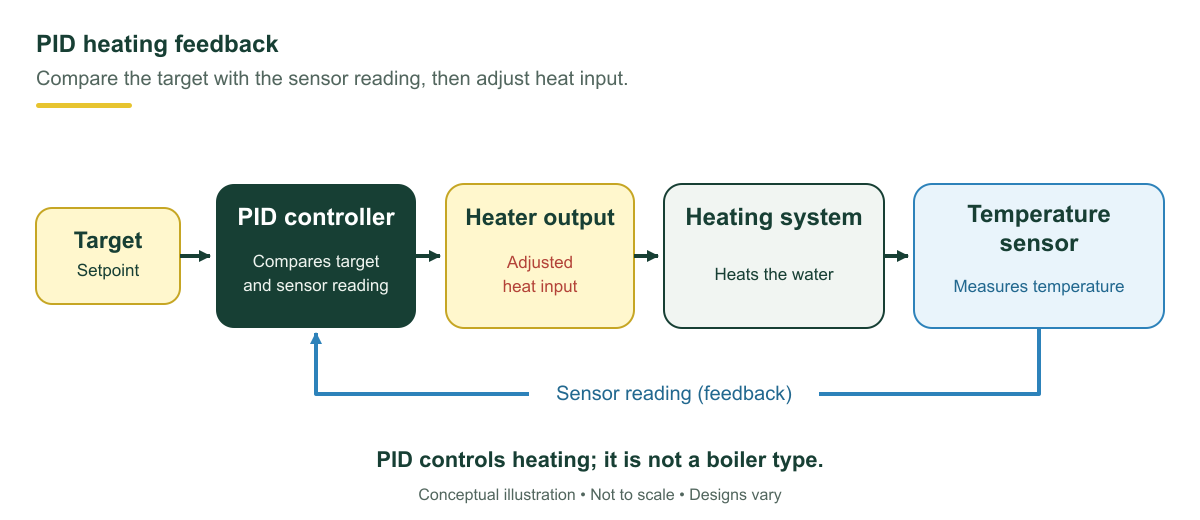
NI's control-engineering guide explains these terms and the importance of feedback, sensor position and system response. Performance depends on how the complete loop is implemented and tuned.
Heat can continue moving from hot metal into water after heater output changes. This thermal delay helps explain why simply reaching a target once differs from regulating temperature as the heating demand changes.
A display may show a target, a sensor reading or a value adjusted to represent another measurement location. Ask what is measured, where it is measured and what the displayed number means.
A stable display alone does not establish the temperature at every point along the water path. Sensor location, water flow and heat transfer between components affect how a measured temperature relates to conditions elsewhere in the system.
Water and metal parts warm through different heat-transfer paths. A heater reaching its target and a preparation routine that includes warming the group and portafilter are different readiness milestones. Compare the same starting conditions, and use the manual's preparation routine when assessing a warm-up claim.
Check the drink sequence. Making an espresso, preparing milk and returning to brewing places different demands on the system. A useful demonstration follows the sequence you expect to use, including any waits or mode changes.
Confirm how power is shared. Separate boilers do not establish that both heaters are always energised together. A design may allow simultaneous heating or allocate available power between heating duties. Confirm which behaviour applies to the supplied electrical version and operating mode.
For the separate supply checks, use the ITOP voltage and plug guide. Warm-up, temperature recovery and electrical compatibility are separate parts of assessing a machine.
PID describes a control method. Identify the heating hardware and the control method separately.
It identifies a heating arrangement. Confirm the machine's rated use, supply requirements and performance under the workload you plan to run.
Yes. First establish what each display represents and how the measurements were made. Then compare performance using the same preparation and test conditions.
Yes. Designs may share a heater between brewing and steaming or use dedicated heating units. The arrangement determines the available operating sequence.
When exploring the ITOP coffee machine range, look at the complete heating configuration and the documented operating workflow for each model.
For a home coffee bar, describe your usual drinks and acceptable preparation time. For a café or equipment project, add the expected drink sequence and steaming demand. Those details give ITOP a clearer basis for discussing suitable configurations.