For distributors, private-label brands and coffee businesses, a useful first OEM coffee equipment enquiry starts with a clear specification. Name the equipment, separate your first order from future estimates, and explain what you want to change. This checklist helps you prepare a request for quotation (RFQ), compare the response and record sample findings before confirming an order.
ITOP supplies coffee machines, grinders and roasters and assesses product-specific OEM/ODM requests. Available options and order conditions depend on the selected model and project.
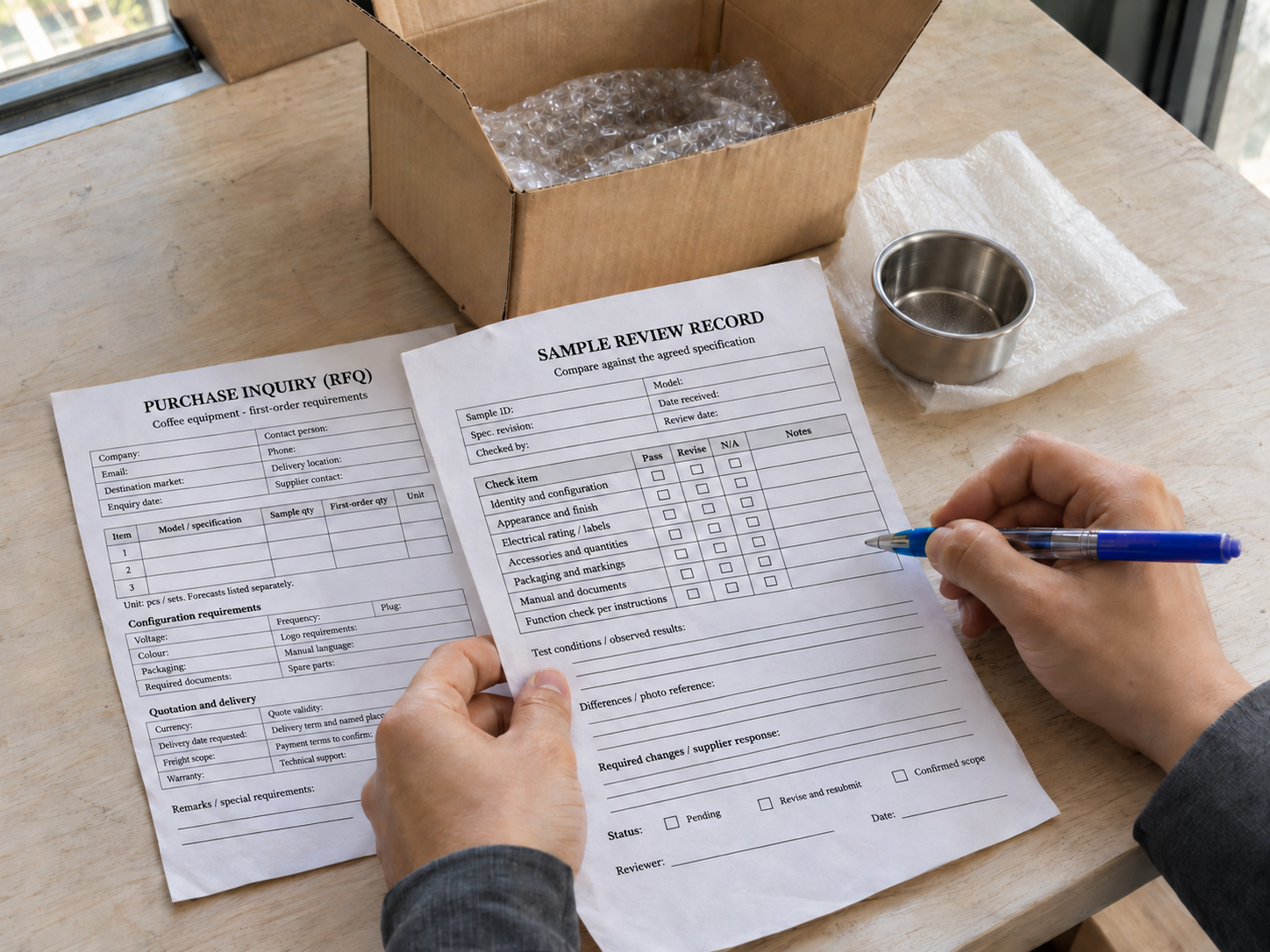
Describe the work you need rather than relying on “OEM” alone. Your enquiry may cover standard equipment for wholesale, an existing platform with branding or packaging changes, or proposed structural and functional changes. Structural or functional changes require a separate assessment. A logo change does not establish that other modifications are available.
Use the product catalog to prepare a shortlist, then identify the exact product and variant in your enquiry.
| Item | What to send |
|---|---|
| Product | Product link, model and variant, plus intended use and expected workload. |
| Quantities | Sample quantity and proposed first-order quantity separately. Label future repeat-order estimates as forecasts, not confirmed orders. |
| Destination and setting | Destination country, target sales market and use: café, hotel, retail resale or another setting. |
| Electrical requirements | Required voltage, frequency, phase and plug or connection details for the destination. Identify anything still awaiting confirmation. |
| Branding and packaging | Requested logo position, artwork, colour, manual language, labels and packaging changes. Separate essential requirements from preferences. |
| Parts and support | Requested spare parts, documentation and support arrangements for your team or customers. |
| Timing and delivery point | Requested sample and order dates, the delivery location and any fixed opening or launch date. These are targets to discuss. |
For electrical preparation, refer to the voltage and plug guide. Regional references do not confirm compatibility of a particular machine version.
Check that the quote identifies the model, configuration, quantity, currency and validity period. Ask for sample charges, customization or setup charges, packaging changes and requested spare parts to be shown separately where applicable.
Record what the quoted amount includes: equipment, packing, freight, insurance and any other stated services. Confirm who arranges and pays for transport, clearance, duties, taxes and destination charges. Ask about payment stages and which events start preparation or production.
If an Incoterms® rule is used, record the chosen rule, precise named place or port, and edition. Avoid a quotation that gives only an unexplained abbreviation. See the ICC overview of Incoterms® 2020 for the rules' allocation of costs, risk and responsibilities.
Ask how sample preparation, order preparation and transport timing are stated. A requested arrival date needs a confirmed plan; it is not itself an agreed lead time.
Before evaluation, assign a sample record number and note the model, configuration, serial number where available, and specification revision. Ask which requested features the sample includes. An initial sample may not contain the final branding, packaging or every proposed change.
| Check | Record |
|---|---|
| Identity and configuration | Model, rating plate, controls, finish and agreed options; photograph identifying details. |
| Permitted function checks | Functions and cleaning checks allowed by the supplied instructions. Record the supply, settings, conditions and observed results. |
| Accessories | Received parts against the agreed list, including quantities and any missing or substituted items. |
| Packaging and labels | Condition on arrival, protection, markings and artwork against the agreed sample scope. |
| Documents | Manual language and revision, specification, parts information and requested market-specific documents for the exact configuration. |
| Differences | Expected item, observed difference, photo or test reference, and the supplier's written response. |
Keep each unresolved difference open in the record. Agree in writing whether it requires a corrected sample, revised drawing, additional evidence or an accepted exception. Identify the version you approve and exactly what that approval covers.
Before proceeding, reference the approved specification revision and sample record, together with any accepted exceptions. Confirm artwork, electrical version, accessories, packaging and documents. Identify which items remain open and agree how later changes will be recorded.
Discuss any requested batch inspection or pre-shipment checks: what will be checked, by whom, how units will be selected and what records are expected. Agree how discrepancies will be handled. Sample approval alone does not describe the inspection arrangements for a larger order.
Also confirm warranty terms, the information needed for a fault report, and available spare-parts and technical-support arrangements. The ITOP project-support overview describes these as product- and project-specific discussions.
Replace the blanks with your requirements. Leave an item marked “to confirm” if you do not yet know it.
Product link / model / variant: __________
Intended use and expected workload: __________
Sample quantity: __________
Proposed first-order quantity: __________
Future estimate, not a confirmed order: __________
Destination country / target market: __________
Electrical requirements: __________
Requested branding / packaging changes: __________
Required documents / parts / support: __________
Target sample date / order date: __________
Requested delivery point: __________
Please confirm available options, minimum quantities,
sample scope, itemized costs and proposed arrangements.
Use one record for each sample check. Copy the block and fill in the agreed requirement, what you observed and the action needed. Keep the sample and specification versions identifiable.
RFQ / order reference: __________
Product link / model: __________
Configuration / specification revision: __________
Sample ID / build version: __________
Check / component: __________
Agreed specification / reference: __________
Observed sample / finding: __________
Method / conditions / evidence reference: __________
Result (matches / difference / not checked / n.a.): __________
Difference / impact: __________
Required action: __________
Responsible person / target date: __________
Approval decision / conditions: __________
Approved by / date / written record reference: __________
Confirm the final configuration, accepted differences and unresolved actions in writing before production confirmation. A blank record does not indicate approval.
Download the blank Excel workbook to list the models, quantities and configuration questions for your enquiry. Its second worksheet records the agreed sample specification, observed differences, required actions and approval decisions.
Download the RFQ & sample workbook (.xlsx)
Use it to prepare your enquiry and share the completed workbook with your ITOP sales contact. Final availability, commercial terms and production requirements need written confirmation for the selected product and order.
Minimum quantities vary by product and project. Ask about the selected configuration and requested changes rather than assuming a standard equipment quantity also applies to customization.
Ask for confirmation of sample availability, configuration, price and shipping arrangements. Include those details in the quotation you review.
Request documents applicable to the exact model, configuration and target market. Record their scope alongside the specification; a general certificate image does not establish coverage of every order.
Have your shortlist and requirements ready? Send them through the website so the ITOP team can assess the selected equipment and project.